
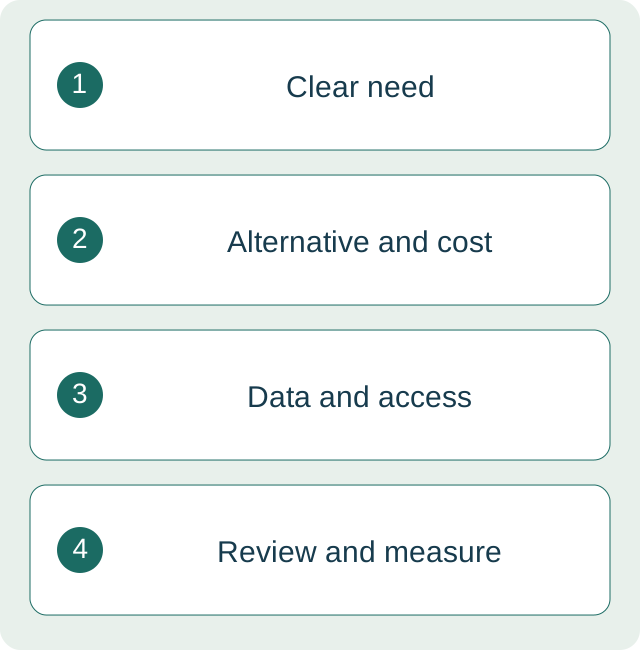
Stanford HAI’s emphasis on augmenting human capabilities informs this guide. The seven questions are our original rapid decision tool, not a standard issued by the institute.
1. Who needs help and with which task?
Listen to the person’s own account before writing a prompt. Define an observable task: preparing an activity, comparing options or organizing notes. Income, diagnoses and children’s names are not needed to identify a basic task.
2. What is the simpler alternative?
Compare with paper, a spreadsheet, an existing guide or a human discussion. AI may help with a draft while remaining unnecessary for the decision. Choose the method that completes the task with the least burden.
3. What is the full cost?
Count subscriptions, connectivity, equipment, review time and printing. Verify current limits before describing a service as free. Set a budget ceiling and identify who bears the cost.
4. Which data are necessary?
Use public or invented data when sufficient. Remove names, contact numbers and home locations. Do not upload a medical record, child’s image or sensitive local knowledge for a casual experiment.
5. Can the task work offline?
Offer a paper or printable version and a text alternative. Ask people who cannot use a phone. If connectivity is essential, disclose and test its cost.
6. Who reviews and has authority?
Name the responsible reviewer, what they check and when they reject an output. Teachers retain educational decisions; relevant specialists review engineering and ecological decisions. A ceremonial approval button is not meaningful oversight.
7. How will we know it helped?
Define a measure, a comparison and a stop condition before starting. Compare quality, time and cost, and ask the user. Faster work with more errors is not automatically a success.
Worked proposal
A teacher wants a 20-minute water-conservation activity. The alternative is an existing worksheet. An AI trial uses the topic and a broad age range, without student names. The teacher checks every fact and instruction and offers a paper version. The trial is limited to one preparation session using an already available tool. Compare time and corrections with the existing sheet; choose the sheet if review takes longer. This is a hypothetical teaching example, not a field result.
Three possible decisions
- Run a small trial when need, review and measurement are clear.
- Revise the design if cost or access is unsuitable.
- Stop if it requires unnecessary sensitive data or an unreviewable decision.
Practice workbook
Read the steps here, or download the workbook for offline use. Your responses are not uploaded to this website.
Last reviewed: 7 October 2026 · Version 1.0
Sources and scope of reuse
Sources accessed 7 October 2026. Publication dates are not stated on the overview pages and are not inferred. Text, examples, templates and diagrams are original DJAIRI work. Links support the specific ideas identified above; they do not imply partnership or endorsement. Third-party images and extended passages are not reproduced.